Using LinkedIn to Generate Alumni Story Ideas: Part 1
Finding alumni success stories to share in alumni magazines, online news stories, and recruitment marketing materials can sometimes seem like a daunting task for college communications professionals. But with all the social media tools at your disposal, it’s never been easier to find out what alumni are doing.
The next time you’re asked to find alumni story ideas turn to LinkedIn first. On LinkedIn, you can see aggregate data on companies that hire the most alumni from your school, and you can search by your college name to find alums and check out what they’re doing today. Here’s how.
FINDING COLLEGE ALUMNI ON LINKEDIN
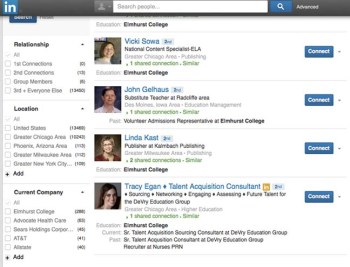
LinkedIn alumni search results
Step 1: Log in to LinkedIn and click on Advanced Search. The Advanced Search box will give you several options of information to enter. In the School box, enter your college’s name.
Step 2: The default results will show you people from your school who share your connections. To search all of LinkedIn for alumni (not just your connections), check the All box under the Relationship section to the left of your results.
Step 3: To review results, click on each page of results or the Next button. If you’re looking for a specific type of alum (such as a recent alum who’s been in the workforce less than 5 years, or an alum working in the financial services or hospital/health care industry), you can narrow results using the categories on the left: Current Company, Industry, Past Company, School, Years of Experience, Function, Seniority Level, etc.
Step 4: Before you use information you find here, contact the alumnus or alumna to confirm the information is up-to-date. If one alum’s job or company sounds interesting, contact him or her to schedule an interview so you can learn more and get a story for your website or alumni magazine, or get a quote for a recruitment marketing brochure.
In my next blog post, I’ll cover how to find alumni employment data on LinkedIn.
About Dana’s Creative Services
Dana’s Creative Services is a writing and editing services company that helps businesses communicate better with their target audiences. Dana McCullough, owner of Dana’s Creative Services, writes and edits copy for brochures, newsletters, websites, blogs, magazines, and books. Her clients include universities, nonprofit organizations, magazine publishers, and book publishers nationwide. Dana has a bachelor’s degree in journalism and frequently writes and edits copy on higher education, genealogy/family history, health, and business topics. Twitter: @DanasCreative
5 Ways to Save Costs on University Marketing Mailings
 College and university marketing budgets are tight. Budgets may not increase as paper, postage, and printing costs increase, but direct mail is still an important part of an integrated marketing campaign.
Over the years I spent working in higher education communications, I learned a few tricks to cut costs of direct mail pieces. Here are a few of those tricks that may help you cut costs, too.
Paper weight
Each printer usually has a standard sheet they use on most projects. Ask your printer what its standard sheet is. Is it an 80# gloss text? A 70# matte text? If you typically print your tri-fold marketing brochure on a 100# gloss text sheet, and the printer’s standard sheet is 80# gloss text, consider making a change.
In most cases, adjusting the paper weight won’t produce a noticeably different result. If you use the sheet the printer uses the most of, you may be able to get a price break.
Paper size
Find out from your printer what the largest sheet size is for the paper you’re using. The less paper sheets you use, the lower the cost. If you’re creating a postcard and the largest sheet for the postcard paper is 11×17, you can do the math to figure out what size to design your postcards in order to maximize the space on a single sheet. This way you might be able to get six postcards, rather than four, from a single sheet, thus reducing your costs.
You can do this on all projects—from marketing postcards and trifold brochures to alumni newsletters and magazines.
Folding
Folding came in handy to save money on an alumni newsletter I created several years ago. Having the printer fold our 12-page newsletter to mail saved us big bucks in postage. The reason was that by folding the newsletter in half, it could mail at letter prices rather than as a flat.
If you really need to save some cash to balance your budget, consider folding a newsletter-style piece. In addition to saving money, it also helped prevent it from being torn up in the mail.
Quality of your mailing list
This is important, especially on large mailings. For every mailing you do, you should get your mailing list NCOA (National Change of Address) certified. NCOA certification compares your mailing list with change of address information provided to the U.S. Postal Service in the last four years.
The printing and/or mailing house you use should be familiar with this. Running your list through NCOA certification may cost a small fee, but it will be well worth it if you don’t waste money sending to incorrect addresses. Plus, you may be able to reduce your print run (and your printing costs) if a large chunk of the addresses on your list end up being removed via the certification process.
Bundling printing and mailing projects
As you plan deadlines and mailing dates for marketing pieces, consider which items can be bundled for printing and mailing. For example, if you need to create three postcards, and all go to different audiences but can be dropped in the mail at the same time, bundle these together. If the postcards are all the same size, you can save money because you’ll be buying in bulk.
About Dana’s Creative Services
Dana’s Creative Services is a writing and editing services company that helps businesses communicate better with their target audiences. Dana McCullough, owner of Dana’s Creative Services, writes and edits copy for brochures, newsletters, websites, blogs, magazines, and books. Her clients include universities, nonprofit organizations, magazine publishers, and book publishers nationwide. Dana has a bachelor’s degree in journalism and frequently writes and edits copy on higher education, genealogy/family history, health, and business topics. Twitter: @DanasCreative
The Most Overused Terms in College Marketing
 Over the years, I’ve seen numerous lists of words overused in press releases or other marketing materials. Today, I’ve come up with my own list of terms I see overused in college recruitment marketing brochures, advertisements, and websites.
If you really want to set your school apart from others, avoid using these words and phrases that others use.
- Small class sizes (most overused!)
- Hands-on (often used in phrases like hands-on research, hands-on experience, hands-on education)
- State-of-the art
- Cutting-edge
- Unique
- Innovative
- Personal attention (also personalized attention)
- Rigorous academics
- Award-winning (usually pertains to faculty or the overall university)
- Conveniently located
- Quality education
In most cases, adjusting the copy slightly can help you avoid these overused terms.
Give concrete examples of the “hands-on” work students do in a laboratory or classroom. Tell me what supercomputer or specific top-of-the-line microscope you have instead of telling me you have “state-of-the-art” facilities or labs. Provide examples, quotes, or anecdotes that show experiences that differentiate your college’s offerings from other colleges, rather than just calling your services or offerings “unique.”
Additionally, if you’re looking for words to replace these overused ones, check out Rhyme Zone, an excellent free online thesaurus that provides not only synonyms, but also related words. Even if you don’t use any of the words they suggest, it may help you brainstorm and provide the creative inspiration you need.
How do you avoid using overused terms in your marketing materials? Leave a comment on this post or tweet me @DanasCreative on Twitter.
Image credit: Created courtesy of Wordle.net
About Dana’s Creative Services
Dana’s Creative Services is a writing and editing services company that helps businesses communicate better with their target audiences. Dana McCullough, owner of Dana’s Creative Services, writes and edits copy for brochures, newsletters, websites, blogs, magazines, and books. Her clients include universities, nonprofit organizations, magazine publishers, and book publishers nationwide. Dana has a bachelor’s degree in journalism and frequently writes and edits copy on higher education, genealogy/family history, health, and business topics. Twitter: @DanasCreative
College Marketing: Finding a Voice That Speaks to Today’s Teens
 Before a recent campus visit at a small liberal arts college campus for a copywriting project, a colleague of mine and I discussed how to find the right voice to speak to prospective students in high school.
She confided in me that she recently went to a local bookstore and picked up stacks of magazines, including Seventeen for girls and, for lack of a better option, a skateboarding magazine for boys. In the past, I had done a similar thing: looking to magazines that targeted at teens to discover catchphrases and study the tone of voice used.
When we met with a group of current college students—mainly freshmen and sophomores—of the campus, our eyes were opened when we asked them what magazines they read.
“Magazines?” they said. “I don’t really read magazines. But I do go to a lot of websites.”
Of course this would be their answer. These students are part of the new crop of Generation Z students: the digital natives. Their answer reminded me that those magazines targeting teens are written by “old folks” like me, too, who are trying to be the voice students want to read.
So how do you capture a voice that high school students want to hear? Read what teens are reading. Go to websites where teens go. And find content written for teens, by teens.
According to Niche, Inc., which had high school students in the Class of 2014 rank the websites they use most often, a few of the most popular websites among teens are:
Other studies show video-sharing site Vine and photo-sharing site Flickr increasing in usage among teens.
If you’re not familiar with these sites, check them out. You may learn something about the teenage audience and their interests—and you can then adjust the voice and style of your copy to better speak to them. It also could inform your decisions on where to spend your online marketing dollars.
Image credit: Courtesy of imagerymajestic/FreeDigitalPhotos.net
About Dana’s Creative Services
Dana’s Creative Services is a writing and editing services company that helps businesses communicate better with their target audiences. Dana McCullough, owner of Dana’s Creative Services, writes and edits copy for brochures, newsletters, websites, blogs, magazines, and books. Her clients include universities, nonprofit organizations, magazine publishers, and book publishers nationwide. Dana has a bachelor’s degree in journalism and frequently writes and edits copy on higher education, genealogy/family history, health, and business topics. Twitter: @DanasCreative
College Marketing: New Insights on Student and Parent Digital Communication Expectations
 Have you seen the latest Noel-Levitz E-Expectations survey results? The results were very insightful. Here are three findings that surprised (and pleased) me:
1. Nearly all high school seniors and their parents will open an e-mail from a campus they are considering. As a former college recruitment marketing professional, I often wondered if the e-mails we carefully and strategically crafted each year had an impact. It appears students and parents do at least look at the e-mails, as long as the student is already considering your school.
This is good news and validates all the time and attention spent on crafting these e-mails. And it reinforces the importance of e-mail communication with students and parents who have not only inquired, but also who have applied and been accepted to your college.
2. Nearly 40 percent of high school seniors use Twitter. Just a couple of years ago, I heard much debate on college campuses on whether it was time for the recruitment offices to jump on the Twitter bandwagon. At the time, only a small number of teenagers were on Twitter, and at smaller colleges (with smaller communication and marketing staffs) they wanted to make sure they put their resources where they would reach the most potential students.
This new stat means that if your college isn’t on Twitter, now’s the time to jump in. And if the recruitment and admissions team isn’t involved in your college’s social media, now’s the time to get them into the fold.
3. More than half of students and parents are willing to receive text messages from campuses. As smartphones have become commonplace (90 percent of high school seniors and 80 percent of parents have access to a mobile device, according to the survey), it seems students and parents are becoming more receptive to receiving communication from colleges on their personal mobile devices.
This finding is contrary to a commonly held notion that teens think of their device as “their space” and don’t want colleges or marketers to infringe on that space by texting them. It appears texting is becoming a more widely accepted method for colleges to communicate with students. If your marketing team hasn’t yet considered incorporating texting as part of your recruitment communication flow, now may be the time to start exploring it.
Did anything surprise you in the Noel-Levitz survey? Leave a reply here or message me on Twitter @DanasCreative.
Image credit: Kromkrathog/FreeDigitalPhotos.net
About Dana’s Creative Services
Dana’s Creative Services is a writing and editing services company that helps businesses communicate better with their target audiences. Dana McCullough, owner of Dana’s Creative Services, writes and edits copy for brochures, newsletters, websites, blogs, magazines, and books. Her clients include universities, nonprofit organizations, magazine publishers, and book publishers nationwide. Dana has a bachelor’s degree in journalism and frequently writes and edits copy on higher education, genealogy/family history, health, and business topics.
Amazing Faculty Work and Personal Stories Create Impactful University Magazine Articles
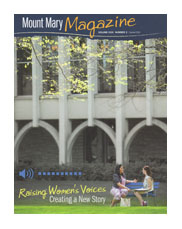 When I was asked to write a couple of articles for the summer edition of Mount Mary Magazine, the magazine issue theme intrigued me: raising women’s voices. For the articles, I had the opportunity to speak with several Mount Mary University faculty about the work they and their students do to help give women a voice and to strengthen women’s voices in the community and the world.
What I found were amazing faculty! The faculty members had very personal stories that impacted the professional work they do, and the women that they teach.
- Dr. Kristen Roche, the MBA program director, witnessed early in her business career how gender may impact job titles given to employees with the same experience. She now is passionate about helping students learn to negotiate in the workplace for better pay, benefits, and jobs.
- Rachel Monaco-Wilcox, chair of the justice program, became a lawyer after being frustrated about the lack of help available for certain populations. Recently, she founded a free legal clinic, Legal Options for Trafficked and Underserved Survivors (LOTUS), to help human trafficking victims and other survivors of crime. She’s also revolutionizing justice education by focusing Mount Mary’s program on a survivor-informed perspective of justice.
- Dr. Jennifer Peterson, assistant professor of communication, discovered how misconceptions about AIDS and HIV impacted women and their voices during a research project in grad school. As a professor today, she teaches her students, particularly students studying health communication, to find a cause they are passionate about, as well as to ensure all people’s voices are present in conversations about health topics.
- Dr. Bruce Moon, chair of the Art Therapy Department, overcame his turbulent teenage years by engaging in art. He’s spent his career helping others cope with their feelings and life struggles through art therapy.
- Dr. Lynn Kapitan, director of the Professional Doctorate in Art Therapy program, began her career as a public school art teacher and ultimately become an art therapist. She travels to Nicaragua each year for community-based art therapy research, which helps women survivors of domestic abuse participate in projects to develop their voices and leadership skills.
To read more about these amazing professors’ stories and work, see my articles on pages 3 through 9 of the Mount Mary Magazine Summer 2014 edition.
About Dana’s Creative Services
Dana’s Creative Services is a writing and editing services company that helps businesses communicate better with their target audiences. Dana McCullough, owner of Dana’s Creative Services, writes and edits copy for brochures, newsletters, websites, blogs, magazines, and books. Her clients include universities, nonprofit organizations, magazine publishers, and book publishers nationwide. Dana has a bachelor’s degree in journalism and frequently writes and edits copy on higher education, genealogy/family history, health, and business topics. Twitter: @DanasCreative
Editor’s Perspective: The Right Way to Treat Titles
 Recently, a client asked for my advice on how to treat book, journal, and article titles in her organization’s communications materials. The question came after some debate within her organization on whether certain titles should be in quotation marks or italicized, and how that formatting would reflect on the organization’s competence and brand.
So what is the right away to format book titles? Well, a post from Writer’s Digest (yes, I did just put that magazine title in italics), has the right answer: it’s up to you, but you (and others at your organization) need to stick with whatever format you choose.
For example, the AP Stylebook encourages using quotation marks for book titles. The Chicago Manual of Style recommends italicizing titles of books, pamphlets, periodicals, newspapers, plays, movies, and TV programs. It also suggests using quotation marks around titles of articles, poems, songs, and TV episodes.
In my experience working with magazine and book publishing companies and university communication and marketing offices, most organizations use the Chicago Manual of Style way for titles, even if they normally adhere to AP style. In fact, all five universities featured in my recent post on editorial style guide examples follow this approach.
It’s okay to have exceptions like these in your editorial style guide. That’s why it’s important to have an editorial style guide specifically tailored for your university or company and the unique editorial situations you encounter.
Overall, what matters more than being right is consistently using the same style (and exceptions) in all of your external and internal communication pieces (website, magazine, brochures, e-mail blasts, etc.). And, if the exceptions are in a written style guide, it helps to have that guide to show anyone who questions your editorial style decisions.
About Dana’s Creative Services
Dana’s Creative Services is a writing and editing services company that helps businesses communicate better with their target audiences. Dana McCullough, owner of Dana’s Creative Services, writes and edits copy for brochures, newsletters, websites, blogs, magazines, and books. Her clients include universities, nonprofit organizations, magazine publishers, and book publishers nationwide. Dana has a bachelor’s degree in journalism and frequently writes and edits copy on higher education, genealogy/family history, health, and business topics.
College Marketing: Why Maintaining Social Media Takes Time
 Time to regularly create and maintain websites, blogs, and social media content is a big concern to many of my clients, particularly colleges and universities. Many colleges and universities are hiring full-time social media managers to handle all of this content, while others continue to add on this responsibility to one (or more) staff members’ job descriptions.
In my experience, some top administrators (you know, the ones who set budgets and make hiring decisions) don’t fully understand the thought, time, effort, strategy, and tracking involved in managing these “free” tools. It’s not always as simple as spending 15 minutes a day creating posts. (Just check out this Business Insider post that shows how a single corporate tweet can take more than a month to create.)
So, why does maintaining social media take so much time?
1. It requires lots of content. The person who manages your social media has to have her pulse on anything and everything happening at the university. To do that, she needs to network with students, faculty, and staff across the entire campus. She needs to coordinate photography of events or happenings to feature on social media. And if new stories, blogs, event listings, or other fresh content aren’t already regularly posted on your website, your social media manager may have to interview sources and write this content herself.
2. It requires a strategy. Some people may advise you to just jump right in and get started with social media without a strategy or plan. But before you spend your time on this, consider these questions: Does the social media tool you want to use really reach your target audience? What is your goal in using a particular social media tool? How are you going to measure success? What type of content are you going to post? Who is going to develop that content and how will that impact their other job responsibilities?
3. It requires constant attention. One of the goals of using social media is to engage your audience. Some of the best, most meaningful interactions you can have with your target audience on social media will be impromptu interactions. Constituents who post questions on your Facebook or Twitter page expect an answer right now.
Your social media manager not only needs to develop fresh content, she needs to interact with your audience members who are trying to engage with your organization. This means she needs to respond to posts, and sometimes she may have to research answers to questions your audience asks.
4. It requires writing and scheduling. Keeping social media posts fresh involves lots of planning. The social media manager needs to strategically decide when items will be posted. For example, you wouldn’t want the post about tonight’s upcoming soccer game to go up tomorrow, would you? The social media manager also needs to write the actual social media posts, confirm the URLs she plans to link to actually work, and convert any images to web-ready formats.
Using a scheduling tool like Hootsuite can help streamline scheduling, but have you tried writing something in less than 140 characters? It’s not always easy. It takes times if you want quality content in the appropriate voice to support your university’s brand.
5. It requires reviewing others’ social media posts. Part of maintaining social media is finding ways to engage with your followers and the people you follow. To engage with your target audience, your social media manager needs to monitor mentions of your organization or hashtags relevant to your mission or initiatives. Once she finds a relevant mention, the social media manager needs to decide which items to share, retweet, or respond to—and then actually do the sharing, retweeting, or responding.
6. It requires tracking to measure success. If you’re doing social media, but aren’t tracking your impact or results, you might be wasting your time. Your social media manager needs to take time to analyze social media analytics, so she can make better decisions about the content to post in the future. After analyzing the data, she can create reports to let the administration know whether all the time spent on a particular social media platform is worth it.
7. The technology is always changing. Twitter and Facebook aren’t the same as they were when they first launched years ago. Social media platforms are always evolving their functionality and design. New social media platforms are launching. Your social media manager needs to keep up-to-date and react to the changes in the technology and tools available.
Of course, there are social media management tools out there that can help automate the process. But many of them cost money, and it takes time to research and learn how to use the best existing tools (and emerging tools) that meet your university’s needs. And, no matter how automated the posting, tracking, and monitoring gets, someone still needs to generate the initial content, review the tracking reports, review the mentions, and then make decisions on what (and where) to post tomorrow.
About Dana’s Creative Services
Dana’s Creative Services is a writing and editing services company that helps businesses communicate better with their target audiences. Dana McCullough, owner of Dana’s Creative Services, writes and edits copy for brochures, newsletters, websites, blogs, magazines, and books. Her clients include universities, nonprofit organizations, magazine publishers, and book publishers nationwide. Dana has a bachelor’s degree in journalism and frequently writes and edits copy on higher education, genealogy/family history, health, and business topics.
Editor’s Perspective: Why Hire an Editor?
 The work that editors do is sometimes undervalued. Of course, as a professional editor, I may be a little biased, but if people could see the work that goes on behind-the-scenes—before a brochure, a book, or even a website is published—they would see the amazing contributions editors make. (Heck, before I post these posts, they go through several iterations to get them just right.)
If you’re on the fence about whether to hire an editor for your next brochure, book, website, blog post, or other writing project, consider these five reasons why hiring an editor is worth it.
1. To get a better product and save time. Whatever you’re writing, after you have an editor review it, the copy should be in an even better state than it was before. An editor may even save you time in the long run, since you don’t have to spend time reviewing your writing for the umpteenth time.
2. To catch errors you might miss. This may seem obvious, but good editors have a keen attention to detail. They see things the writer may not see. With a fresh pair of eyes, an editor will catch any typos you may have overlooked, word usage and spelling errors your word processor’s spelling and grammar check didn’t catch, and gaps in the information presented.
3. To ensure your readers will understand what you write. A good editor will approach your work from the vantage point of your target audience. For example, if you’re writing for teens, but reference the “Saved By The Bell” TV show or “CD-ROMs,” an editor can kindly suggest using more appropriate examples the audience can relate to. If you’re writing for genealogy beginners and you use the acronym FHL, the editor may suggest spelling out the full name of the Family History Library on the first reference so the reader knows what the acronym means.
Plus, if a sentence (or paragraph) just doesn’t make sense, an editor can suggest a way to rewrite it so readers can understand what you’re trying to say.
4. To focus your writing. Sometimes when I write, I do so much research and get so much great information that I just want to put it all in one article. It’s difficult to leave great stuff on the cutting room floor. But overloading a communication piece or article with too many words or too much information could dilute your message and its impact.
An editor can take an objective look at what you’ve written and then suggest places where you can make it more concise, where the focus needs to be shifted to have a greater impact, or where you can re-organize paragraphs to help the copy flow better.
5. To ensure consistency. You’ve seen me blog about consistency and editorial style before, but this is key in creating professional-quality communications materials or publications. For example, do you want to use email or e-mail? Should quotations be attributed with said or says? Do you capitalize job titles?
An editor can make sure the voice and style is consistent throughout your digital or print publication.
Interested in hiring an editor? Contact Dana’s Creative Services to discuss your project and your editing needs.
About Dana’s Creative Services
Dana’s Creative Services is a writing and editing services company that helps businesses communicate better with their target audiences. Dana McCullough, owner of Dana’s Creative Services, writes and edits copy for brochures, newsletters, websites, blogs, magazines, and books. Her clients include universities, nonprofit organizations, magazine publishers, and book publishers nationwide. Dana has a bachelor’s degree in journalism and frequently writes and edits copy on higher education, genealogy/family history, health, and business topics.
College Marketing: 5 Editorial Style Guides to Model Yours After
 A couple of weeks ago, Dana’s Creative Services shared information about why having an editorial style guide is important. It’s not just large universities that have editorial style guides—colleges of all sizes have style guides to ensure their communications and marketing pieces have a consistent style and voice to support their brand.
Today, I’ve found five examples of college and university style guides that you can use as an example when creating your own style guide. If your university doesn’t have editorial style guidelines (or if you’re hoping to update your university’s guidelines), you can use these as inspiration.
1. Iowa State University. This university’s editorial style guide is part of its overall visual identity system that supports its brand. The guide addresses items like acceptable abbreviations to use, how to capitalize academic and administrative titles, formal names for departments, words to avoid using, and capitalization rules.
2. Saint Leo University. Because of this university’s multiple centers across the country, it’s important its staff at all locations adhere to a consistent style to support the university brand. This comprehensive style guide addresses standard descriptions of commonly used terms; key university messages; punctuation; official terminology for university buildings, landmarks, and center locations; and commonly used acronyms.
3. University of Missouri. This university established its writing and editing guidelines to help “ensure clarity and cohesion while reinforcing Mizzou’s distinctive identity.” The editorial style guide include an A-Z list of common terms and word usage (such as adviser, not advisor), info on how to write good captions and headlines, and tips for finding facts about the university, interviewing sources, and fact checking articles.
4. Beloit College. This Wisconsin college’s style guide covers commonly used terms, names and descriptions of campus facilities, how to list alumni graduation dates, and more.
5. Swarthmore College. This Pennsylvania college’s style guide includes guidelines on everything from academic degrees and student organization names to punctuation usage and class note style.
About Dana’s Creative Services
Dana’s Creative Services is a writing and editing services company that helps businesses communicate better with their target audiences. Dana McCullough, owner of Dana’s Creative Services, writes and edits copy for brochures, newsletters, websites, blogs, magazines, and books. Her clients include universities, nonprofit organizations, magazine publishers, and book publishers nationwide. Dana has a bachelor’s degree in journalism and frequently writes and edits copy on higher education, genealogy/family history, health, and business topics.
 Dana's Creative Services, Dana McCullough, Freelance Writer and Editor